Google’s Open Knowledge Format (OKF): packaging knowledge for AI agents — what we learned deploying it
 Phạm Hải Anh · AI engineer··5 min read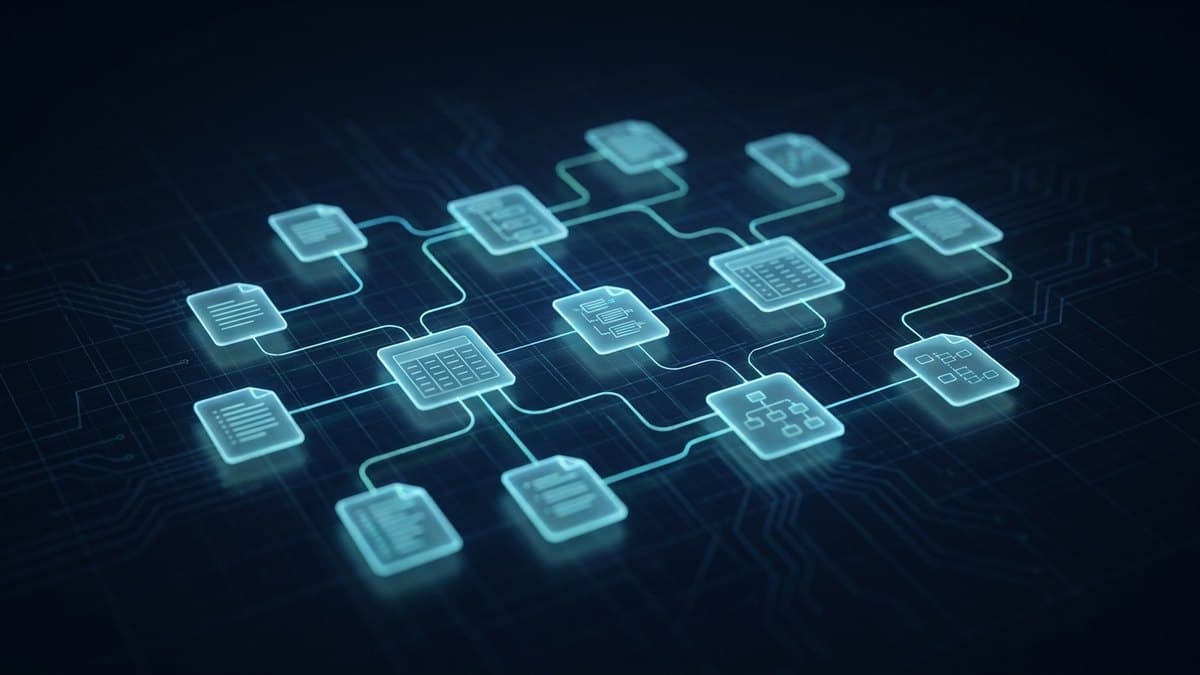
On 12 June 2026, Google Cloud published OKF — the Open Knowledge Format (v0.1): an open, vendor-neutral standard for packaging the *knowledge* an AI agent needs, as a directory of Markdown files. We downloaded the official sample bundles, took them apart file by file, and pulled out the practical deployment lessons below — OKF as it actually runs, not just as a press release.
OKF in one minute
An OKF "bundle" is a directory of Markdown. Each file is one "concept" — a data table, a dataset, a metric, a runbook, an API… any unit of knowledge. The file path is the concept's identity.
Each file has two parts: a YAML frontmatter block (only type is required, with optional title, description, resource, tags, timestamp) and a free-form Markdown body. Concepts link to one another with ordinary Markdown links, and with that the whole directory becomes a knowledge graph.
No SDK, no runtime, no central registry. The spec's spirit fits on a line: if you can "cat" a file, you can read OKF; if you can "git clone" a repo, you can ship it. Why care? An AI agent is only as smart as the context you give it — and OKF standardizes how that context is packaged so many systems can read it.
What we tried
We pulled the three official sample bundles from the GoogleCloudPlatform/knowledge-catalog repo: GA4 e-commerce data, Stack Overflow data, and Bitcoin blockchain data. Reading the spec and every concept inside, here is what stood out.
Seven lessons for deploying OKF
1. The knowledge is in the "how", not the column list. In the samples, each metric carries the actual SQL that computes it; each "join" carries the exact join predicate. Your data catalog already has the schema — what OKF holds is the part that lives in a senior engineer's head: the grain of a table, how a metric is derived, the implicit caveats.
2. Pick a small, consistent set of "type" values. Although the spec only mandates type, the samples reuse just a few values: Dataset, Table, Reference. type is the axis you filter, color, and route on at consumption time — keep it tight and the bundle stays navigable.
3. Relationships live in prose and links, not typed edges. Bitcoin's "transactions" table points to "blocks", "inputs", "outputs" right in the sentences; the graph emerges from those links. Use bundle-absolute links (starting with "/") so they survive files being moved.
4. Generate first, curate second. Google's reference agent runs in two passes: the first drafts a skeleton from the system of record (warehouse metadata), the second crawls authoritative docs to enrich detail and add citations. The lesson: don't hand-write from zero — auto-draft the skeleton, then have people curate the substance.
5. index.md for progressive disclosure. Any directory can carry an index.md listing its contents, so an agent (or human) navigates one level at a time instead of swallowing the whole bundle into context. That matters when knowledge is large and the context window is finite.
6. Embrace imperfection — and ship. Even in the samples, the Stack Overflow dataset's tags field is written as a string instead of a YAML list — but the spec is deliberately permissive: consumers must still read it. Because a bundle is just files in git, curating knowledge becomes ordinary pull requests and diffs; ship, then refine.
7. Make staleness and trust explicit. Beyond the timestamp field, the Stack Overflow dataset states it plainly in prose: "last updated 2022-11-25, no longer maintained." An agent needs to know how far to trust a concept — say it, don't make it guess.
Applying it to a few domains
Data warehouse and BI. Concepts are datasets, tables, metrics, joins. Embed the SQL for each metric and the join key for each relationship. The payoff: no more everyone in the company re-defining "revenue" or "active customer" their own way.
APIs and internal systems. Concepts are endpoints, schemas, playbooks. The body describes request/response, auth, error semantics, and links to runbooks. Reference the OpenAPI file via the resource field instead of copying it — OKF points at other standards, it doesn't absorb them.
Operations and business process. Concepts are policies, playbooks, incident runbooks. This is exactly where OKF shines: packaging the knowledge that otherwise "lives in a few people's heads" — approval steps, how to react to an alert — into documents readable by humans and agents alike.
On-prem AI assistants. Because OKF is plain files, the whole bundle sits inside your git or filesystem behind your firewall; a locally-run model reads it directly, with no cloud metadata service in between. The knowledge never has to leave the building.
How OKF differs from what you already have
Unlike llms.txt: llms.txt is a single guide file for a model; OKF is many typed concepts wired into a graph. Unlike schema.org: that is structured data for browser and search-engine SEO; OKF is knowledge for agents. Unlike RAG: instead of chunking documents and searching by vector, the agent navigates a curated library.
And it complements MCP: MCP (its in-browser sibling is WebMCP) is how an agent calls tools; OKF is how an agent reads knowledge. Our tetra.vn website already exposes tools to agents via WebMCP — OKF is the "knowledge" layer that pairs with that "tools" layer. If you're curious, read our write-up on WebMCP.
Our take
OKF fits the direction Tetra pursues: running AI on-premise, and making products and websites agent-ready. Being plain files plus git, OKF works well behind a firewall — precisely the data-sovereignty problem many organizations in Vietnam care about.
But don't over-hype it. This is v0.1, still very early. The real value isn't producing Markdown — anyone can do that — it's curating the knowledge: choosing the right metric, writing the right definition, stating the right caveat. The hard part, and the valuable part, lives there.
Want a hand?
If your organization wants to turn scattered knowledge — data warehouses, API docs, operating procedures — into an OKF bundle for an AI assistant, especially an on-prem one, Tetra can help from scaffolding to curation. Book a consultation with us.
Related articles
WebMCP: letting AI assistants call tools directly on tetra.vn
WebMCP is a new web standard that lets a site declare its functions for AI assistants to call directly. tetra.vn now supports it, among the first in Vietnam.
Read ↗
Angler: an open-source search, crawl & research gateway you self-host
Angler is a free, MIT open-source search + crawl + research gateway you self-host: web access for AI agents (Claude Code, Cursor…) over MCP or the Firecrawl SDK, turning the web into clean, bias-resistant markdown for research and AI agents.
Read ↗
Vietnamese OCR: turning document images into usable data (safely)
OCR only reads text; businesses need structured data. The difference between OCR and data extraction, why Vietnamese OCR is hard, the risk of free online OCR with sensitive data, and how to do it safely on your own server.
Read ↗Try AI on one concrete problem for 30 days
The AI Pilot measures real impact before a large investment, with a stop point after week one.