Handing over records when administrative units merge: where district-level digital files go
 Lê Thị Hồng Vân · Digital administration specialist··7 min read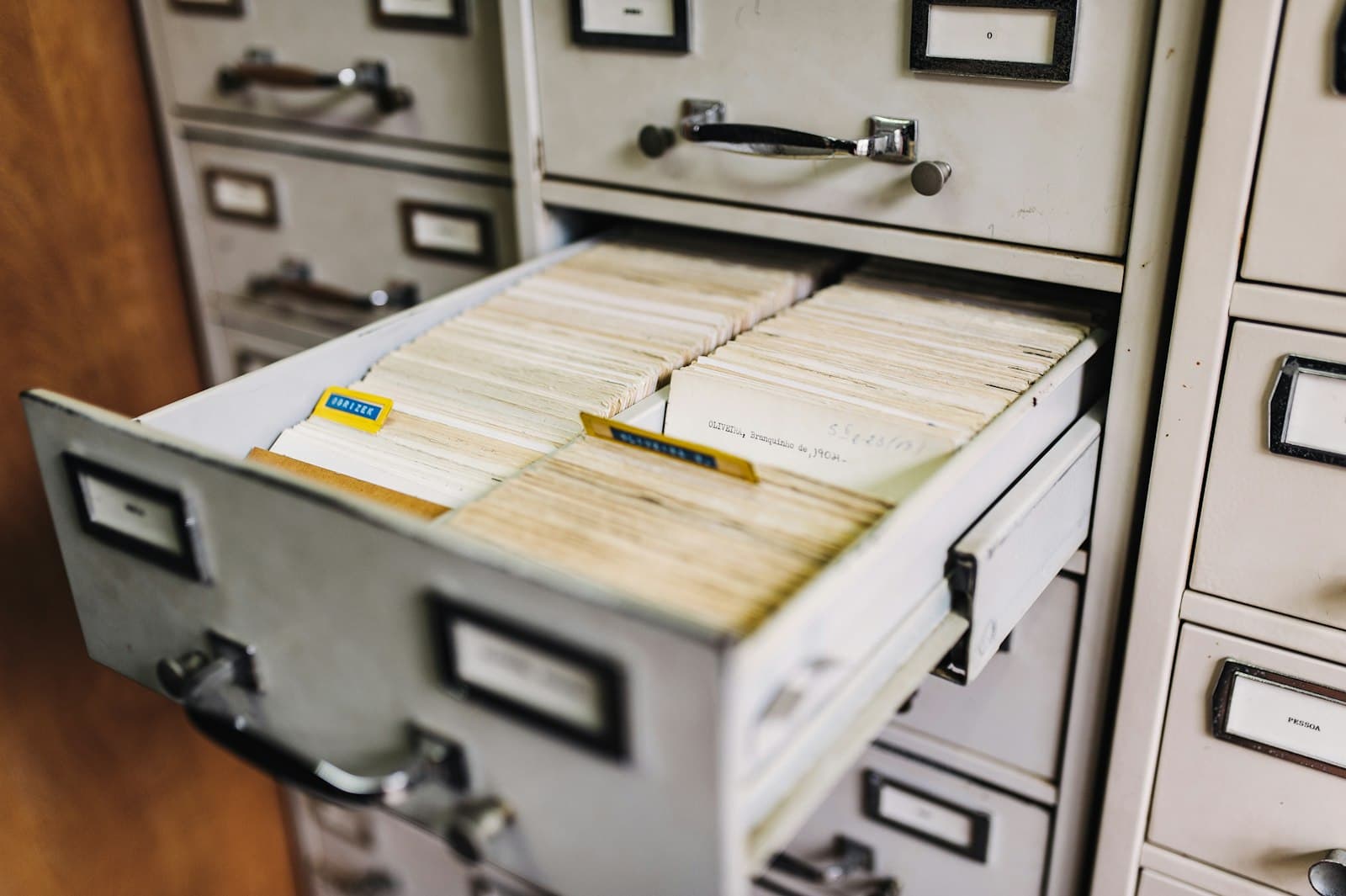
Photo: Maksym Kaharlytskyi / Unsplash
Vietnam's district-level administrations cease operating on 1 July 2025. Most published guidance so far concerns paper: boxes of files, shelving, arrangement work, storage rooms. Yet every district People's Committee also runs a document-management system holding hundreds of thousands of electronic documents, case files, approval workflows and digital signatures — and that part rarely appears in the transition plans.
This article answers the four questions facing records staff, provincial Departments of Home Affairs, and IT units at provincial and commune level: who owns the district's digital records, who extracts them, on what basis, and how long the old system must keep running.
Two different dates: legal and operational
Keeping these apart matters when writing handover minutes.
- Resolution 202/2025/QH15 of 12 June 2025 reorganised provincial-level administrative units, leaving 34 provinces and centrally governed cities. Accompanying resolutions reorganised the commune level down to 3,321 communes, wards and special zones.
- Law on Organisation of Local Government No. 72/2025/QH15** was passed by the National Assembly on 16 June 2025 and took effect on the date of passage, establishing the two-tier local government model.
- 1 July 2025 is the operational date. From then the two-tier structure runs for real and district-level units cease to exist.
So the legal instruments are already in force while the actual data transfer has barely started. Those few weeks are the entire technical preparation window.
What Article 40 of Circular 06/2025/TT-BNV requires
Circular 06/2025/TT-BNV of 15 May 2025**, issued by the Ministry of Home Affairs, details several articles of the 2024 Law on Archives. It has 8 chapters, 44 articles and 16 appendices, and takes effect on 1 July 2025 — the same day districts stop operating. Law on Archives No. 33/2024/QH15 takes effect on that date too, replacing the 2011 law.
Article 40 deals specifically with district-level units ceasing operation, and splits into two branches.
For paper records and other physical media: the Chairperson of the provincial People's Committee assigns the provincial historical archive to receive and arrange them under Article 65 of the 2024 Law on Archives. After arrangement, permanently preserved records go into the historical archive, while records with a limited retention period go to the directly managing agency.
For digital records — the part seldom discussed — Article 40 requires the competent body to:
- Determine the scope of records belonging to each agency by account or by identifier code.
- Extract that body of records and transfer it to the provincial historical archive, ensuring it remains accessible.
- Keep operating the old system for retrieval until all records have been moved to the new system.
Three short clauses on paper; three separate technical projects in practice.
What "extract by identifier code" actually means
Inside a district document-management system, documents are not conveniently tagged with the legal entity they belong to. They are tied to a creator, to a unit in the organisational chart, and to the agency's identifier code when documents move between systems.
Electronic identifier codes for agencies and organisations are set by Decision 20/2020/QD-TTg of 22 July 2020, amended by **Decision 09/2025/QD-TTg of 14 April 2025**. That code table is what answers "which agency does this document belong to" when a shared district repository has to be split. It also means the table itself must be updated to the new administrative map; otherwise every extraction maps onto codes with no remaining owner.
In practice the extraction work has several layers:
- Reconcile the divisions and units listed in the old system, and their old identifier codes, against the agencies that inherit the corresponding functions at provincial or commune level.
- Handle the shared portion: documents issued by the district People's Committee that span several fields now inherited by different agencies. Agree one rule, write it into the handover minutes, rather than letting each operator decide case by case.
- Export metadata, not just attachments. Reference number, issue date, signer, confidentiality level, retention period, processing history — without these fields the transferred set loses its retrievability, which is exactly what "ensuring accessibility" forbids.
Digital signatures and unarranged backlog: the two weak points
Signature integrity during migration. An electronic document has legal value because a digital signature is bound to its content at signing time. If export and import change the file format, recompress the PDF, or detach the signature from the document, verification fails. The safe rule: export signed files untouched, capture signature verification results at handover time, and keep a record of those results. Any format conversion, if unavoidable, must be a separate documented step rather than something folded into extraction.
Unarranged backlog. Nearly every district still holds records that were never fully organised: loose documents never attached to a case file, files left open for years, scanned material never catalogued. That backlog does not disappear when the system is switched off. The pragmatic approach is to hand it over as-is with an inventory that states plainly which parts are unarranged, instead of rushing arrangement work in a few weeks and producing bad data. The receiving provincial archive can arrange it properly afterwards.
Access after handover. Commune staff still need to look up files the district handled in order to finish work already in progress: land, civil status, construction permits, complaints. If records are simply deposited into an archive with no retrieval channel, day-to-day work stalls. Decide in advance who may see what, through which interface, and log every access to the legacy set.
Running two systems in parallel: cost and risk
Article 40 allows the old system to keep running until the transfer completes. That is sensible, but parallel operation is not free:
- Servers, software licences and operating effort still cost money, while the agency that owned the budget no longer exists.
- Legacy systems usually stop receiving patches and become a security liability. If one must stay up, put it in read-only mode, narrow access to a controlled group of accounts, and place it behind a network protection layer.
- Two systems holding the same data invite two versions of the truth. State it clearly: from 1 July 2025, new records are created only in the new system; the old one is for retrieval.
- Without a deadline, "temporary" lasts years. Set an end date at the start and tie it to extraction progress.
Checklist for IT and records staff
Work to do immediately, before and during the transition week:
- Inventory every system holding district digital records: document management, one-stop-shop, official email, shared file stores, sector databases. Note who currently administers each.
- Freeze a full backup as of 30 June 2025, keep it in two locations, and test a restore at least once. This is the baseline for every later reconciliation.
- Produce a mapping table from old units and identifier codes to the receiving agencies, confirmed by the provincial Department of Home Affairs.
- Count what exists: incoming and outgoing documents, case files, total attachment volume. These numbers go into the handover minutes and serve as the check after extraction.
- Pilot the extraction on one division before running it across the whole system; verify metadata and digital signatures on a random sample.
- Define which accounts may access the old system after 1 July 2025, revoke the rest, and turn on access logging.
- Sign handover minutes between the transferring party, the receiving party and the technical team performing extraction, attaching the inventory and verification results.
- Set a target date for shutting the old system down, and the conditions that must be met first.
Preparing the receiving system
The district's digital records will end up in two places: the provincial historical archive and the live document-management system of whichever agency inherits the function. The receiving system therefore has to import legacy data together with its metadata, preserve signed files byte-for-byte, apply permissions by agency, and log access. On the separate question of creating and processing documents day to day under the two-tier model, we covered that in our article on digitising official documents under Decree 30/2020.
Tetra eOffice is deployed on-premise on the organisation's own infrastructure. It supports importing data from legacy systems, digital signing to Vietnamese standards, permissions aligned to the organisational structure, and full access logging — which is what keeping a transferred record set genuinely accessible requires.
Conclusion
Handing over records when administrative units merge is not only a matter of boxes and shelves. The harder part is digital: scoping each agency's records by identifier code, extracting them with their metadata, preserving the legal value of digital signatures, and managing a parallel-running period so it does not stretch indefinitely. Article 40 of Circular 06/2025/TT-BNV sets the principles; the technical plan is each locality's own work.
If your organisation is preparing to receive a district-level digital record set, book a consultation and we will review the current systems and the extraction and handover approach with you.
Related articles

Document management software: must-have features and how to choose
How document management software differs from a shared drive and from an official-correspondence system, the five kinds of solutions on the market, a must-have feature list and the questions to ask vendors before signing.
Read ↗
Electronic case file management: rules and required features
Electronic case files under Decree 30/2020, the 2024 Archives Law and Circular 05/2025: who must keep them, the 60-day transfer deadline for digital files, required software features and the July 2027 milestone.
Read ↗
Free warranty and repair management software: does it exist?
Three different kinds of free, a common mix-up between maintenance and repair software, the options with no licence fee, and the costs the word free does not cover.
Read ↗See Tetra eOffice handle real documents
A demo on a sample system: registration, routing, deadline tracking and digital signing.